Home Articles Books Search About
日本語
GakuNin RDM Search API (`/api/v1/search/`) Investigation Memo

GakuNin RDM Search API (`/api/v1/search/`) Investigation Memo

Investigation date: 2026-02-24 Target: GakuNin RDM (GRDM) Search API Source code: RCOSDP/RDM-osf.io (website/search/ directory) Developer guide: RCOSDP/RDM-developer-guide Note: Official documentation for the Search API could not be found. This article is an investigation record based on both the actual API behavior and the source code. Overview GakuNin RDM is a fork of OSF (Open Science Framework), and its source code is available on GitHub (RCOSDP/RDM-osf.io). The search functionality implementation is in the website/search/ directory and consists mainly of the following files. ...

Building a Django CI/CD Environment from GitHub to EC2 Using GitHub Actions (2023 Edition)

Building a Django CI/CD Environment from GitHub to EC2 Using GitHub Actions (2023 Edition)

Overview I had the opportunity to build a Django CI/CD environment from GitHub to EC2 using GitHub Actions, and here are my notes. The following article was used as a reference. https://qiita.com/fffukken/items/27b0bfa712940914d3f6 I made some updates to the GitHub Actions configuration compared to the above article. GitHub Actions Configuration name: Test and Deploy on: push: branches: [ develop, main ] pull_request: branches: [ develop ] jobs: build: runs-on: ubuntu-latest strategy: max-parallel: 4 matrix: python-version: [3.9, "3.10"] steps: - uses: actions/checkout@v3 - name: Set up Python ${{ matrix.python-version }} uses: actions/setup-python@v4 with: python-version: ${{ matrix.python-version }} - name: Install Dependencies run: | python -m pip install --upgrade pip pip install -r requirements.txt - name: Run Tests run: | python manage.py makemigrations python manage.py migrate python manage.py test - name: deploy run: | echo "$SECRET_KEY" > secret_key chmod 600 secret_key ssh -oStrictHostKeyChecking=no ${EC2_USER}@${EC2_HOST} -i secret_key "source <仮想環境名>/bin/activate \ && cd ~/<プロジェクト名>\ && git pull origin main \ && python manage.py makemigrations \ && python manage.py migrate \ && deactivate \ && sudo systemctl restart gunicorn" env: SECRET_KEY: ${{ secrets.SECRET_KEY }} EC2_USER: ${{ secrets.EC2_USER }} EC2_HOST: ${{ secrets.EC2_HOST }} The changes made were updating the versions of actions/checkout and actions/setup-python. I also changed the pip install section to pip install -r requirements.txt. ...

django-simple-history: Recording Model Edit History in Django

django-simple-history: Recording Model Edit History in Django

Overview This is a personal note from researching how to keep edit history in Django. As shown in the following message, by default, edit history is recorded for changes made through the admin interface, but not for changes made through other interfaces. This object doesn’t have a change history. It probably wasn’t added via this admin site. django-simple-history So I tried using the following package. https://django-simple-history.readthedocs.io/en/latest/ I was able to use it without issues by following the quick start page below. ...

Implementing Partial Match Filters in Django Rest Framework (DRF)

Implementing Partial Match Filters in Django Rest Framework (DRF)

To implement partial match filters in Django Rest Framework (DRF), it is common to use the Django filter backend. This uses the django_filters module. If you haven’t installed this module yet, you can install it with the following command: pip install django-filter Here are the general steps to achieve partial match search: Define a filter set. The following is a filter set for performing partial match search on the name field of a model called MyModel in models.py: ...

Getting the File Path of an Uploaded File Using Django's ModelForm

Getting the File Path of an Uploaded File Using Django's ModelForm

I had the opportunity to get the file path of an uploaded file using Django’s ModelForm, so I am making a note of it. Assume the following model. class Document(models.Model): file = models.FileField(upload_to='documents/') With the above, the path could be accessed using the following views. from django.shortcuts import render, redirect from .forms import DocumentForm def upload_file(request): if request.method == 'POST': form = DocumentForm(request.POST, request.FILES) if form.is_valid(): document = form.save() file_url = document.file.url # Correct field name used here full_path = document.file.path # Correct field name used here return redirect('some-view') else: form = DocumentForm() return render(request, 'upload.html', {'form': form}) This may be basic, but I hope you find it helpful. ...

Connecting Django with AWS OpenSearch

Connecting Django with AWS OpenSearch

Overview These are notes on how to connect Django with AWS OpenSearch. The following article was helpful. https://testdriven.io/blog/django-drf-elasticsearch/ However, since the above article targets Elasticsearch, changes corresponding to OpenSearch were needed. Changes Changes for OpenSearch were needed starting from the Elasticsearch Setup section of the article. https://testdriven.io/blog/django-drf-elasticsearch/#elasticsearch-setup Specifically, the following two libraries were required. (env)$ pip install opensearch-py (env)$ pip install django-opensearch-dsl After that, by replacing django_elasticsearch_dsl with django-opensearch-dsl and elasticsearch_dsl with opensearchpy, I was able to proceed as described in the article. ...

Bulk Registration with Django REST Framework

Bulk Registration with Django REST Framework

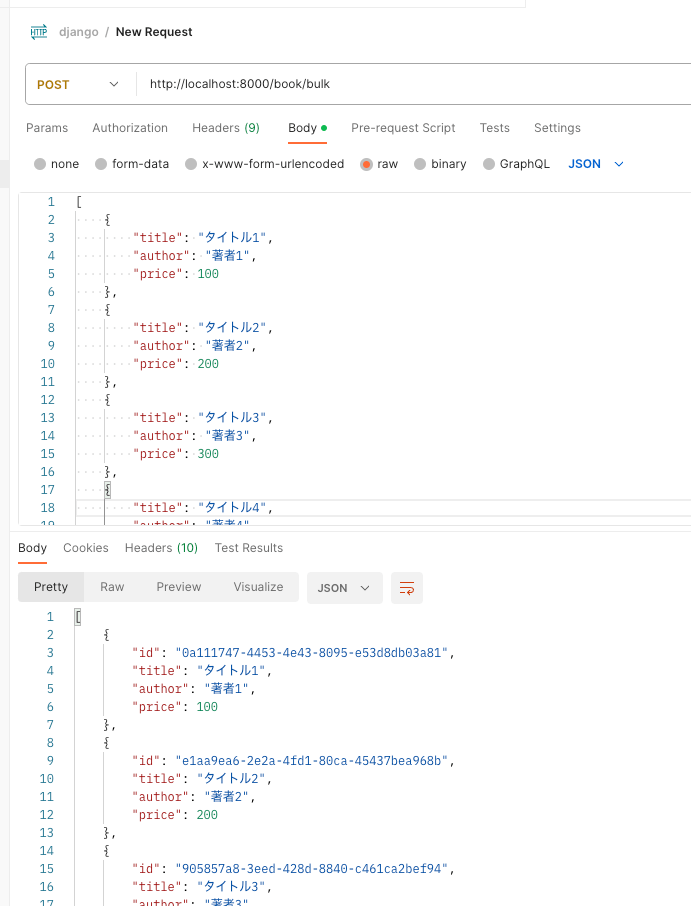
Overview I looked into how to perform bulk registration with Django REST framework, so here are my notes. By following the article below, I was able to create an endpoint for bulk registration. https://qiita.com/Utena-lotus/items/c7bde7f663cfc4aabff1 Postman I sent the following request using Postman. As a result, I was able to perform bulk registration as shown below. Summary I hope this serves as a helpful reference.

Using JWT in Django (djangorestframework-simplejwt)

Using JWT in Django (djangorestframework-simplejwt)

Overview I wanted to use JWT with Django, so I tried djangorestframework-jwt. https://github.com/jpadilla/django-rest-framework-jwt I followed the instructions on the following site. https://dev-yakuza.posstree.com/django/jwt/ However, when I added 'rest_framework_jwt.authentication.JSONWebTokenAuthentication', the following error occurred. ImportError: cannot import name 'smart_text' from 'django.utils.encoding' Upon investigation, I found the following article. https://stackoverflow.com/questions/72102911/could-not-import-rest-framework-jwt-authentication-jsonwebtokenauthentication It suggested using djangorestframework-simplejwt instead. https://github.com/jazzband/djangorestframework-simplejwt Below are my notes on how to use it. djangorestframework-simplejwt I was able to verify its operation by following the page below. ...

Customizing Views for Custom Models in Django REST Framework JSON:API (DJA)

Customizing Views for Custom Models in Django REST Framework JSON:API (DJA)

Overview Let’s customize the views for the model added in the following article. Sort Let’s add ordering_fields. ... class UserInfoViewset(ModelViewSet): ordering_fields = ("user_name", ) # Added here queryset = UserInfo.objects.all() serializer_class = UserInfoSerializer def get_object(self): entry_pk = self.kwargs.get("entry_pk", None) if entry_pk is not None: return Entry.objects.get(id=entry_pk).blog return super().get_object() ... As a result, only user_name became selectable in the “Filters” display. For example, sorting by age returned a validation error. Filter ... class UserInfoViewset(ModelViewSet): queryset = UserInfo.objects.all() serializer_class = UserInfoSerializer ordering_fields = ("user_name", ) # Added from here below # override the default filter backends in order to test QueryParameterValidationFilter # without breaking older usage of non-standard query params like `page_size`. filter_backends = ( QueryParameterValidationFilter, OrderingFilter, DjangoFilterBackend, SearchFilter, ) rels = ( "exact", "iexact", "contains", "icontains", "gt", "gte", "lt", "lte", "in", "regex", "isnull", ) filterset_fields = { "id": ("exact", "in"), "user_name": rels } search_fields = ("user_name", ) ... ... With the above, the following filter became possible. ...

Adding Custom Models to Django REST framework JSON:API (DJA)

Adding Custom Models to Django REST framework JSON:API (DJA)

Overview In the following article, I confirmed the basic operations of Django REST framework JSON:API (DJA). In this article, I will try adding a custom model to DJA. References I will add a UserInfo model, referencing the following article. https://tech-blog.rakus.co.jp/entry/20220329/python Steps Define the Model Add the following: # ユーザ情報を格納する class UserInfo(BaseModel): user_name = models.CharField(verbose_name='ユーザ名',max_length=32) # ユーザ名 birth_day = models.DateField(verbose_name='生年月日') # 生年月日 age = models.PositiveSmallIntegerField(verbose_name='年齢',null=True,unique=False) # 年齢 created_at = models.DateTimeField(verbose_name='作成日時',auto_now_add=True) Build the Database Execute the following: % django-admin makemigrations --settings=example.settings Migrations for 'example': example/migrations/0013_userinfo.py - Create model UserInfo % django-admin migrate --settings=example.settings Operations to perform: Apply all migrations: auth, contenttypes, example, sessions, sites Running migrations: Applying example.0013_userinfo... OK For reference, the following file is created: ...

Trying Django REST Framework JSON:API (DJA)

Trying Django REST Framework JSON:API (DJA)

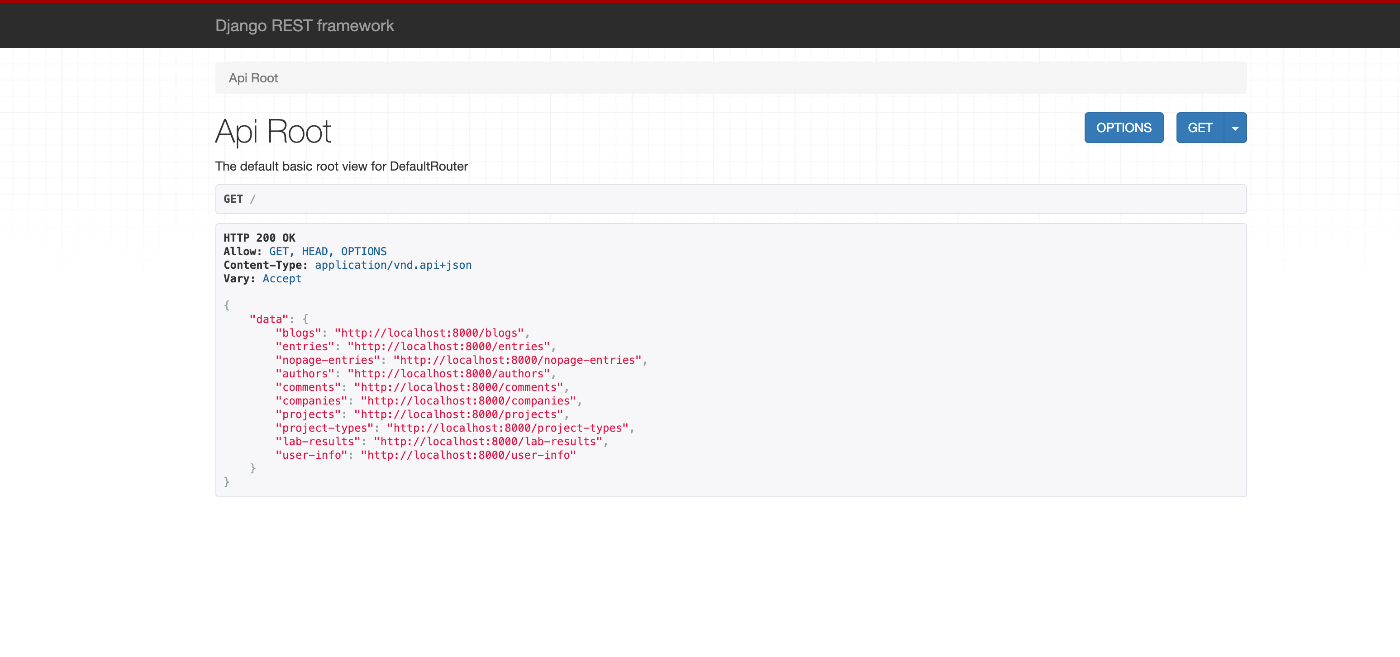
Overview I had an opportunity to try Django REST framework JSON:API (DJA), so here are my notes. https://django-rest-framework-json-api.readthedocs.io/en/stable/index.html Installation Launch the example app described on the following page. https://django-rest-framework-json-api.readthedocs.io/en/stable/getting-started.html git clone https://github.com/django-json-api/django-rest-framework-json-api.git cd django-rest-framework-json-api python3 -m venv env source env/bin/activate pip install -Ur requirements.txt django-admin migrate --settings=example.settings django-admin loaddata drf_example --settings=example.settings django-admin runserver --settings=example.settings As a result, the following screens were obtained. http://localhost:8000 for the list of available collections (in a non-JSON:API format!), ...