Trying Canonical Text Services
Overview Canonical Text Services is described as follows:
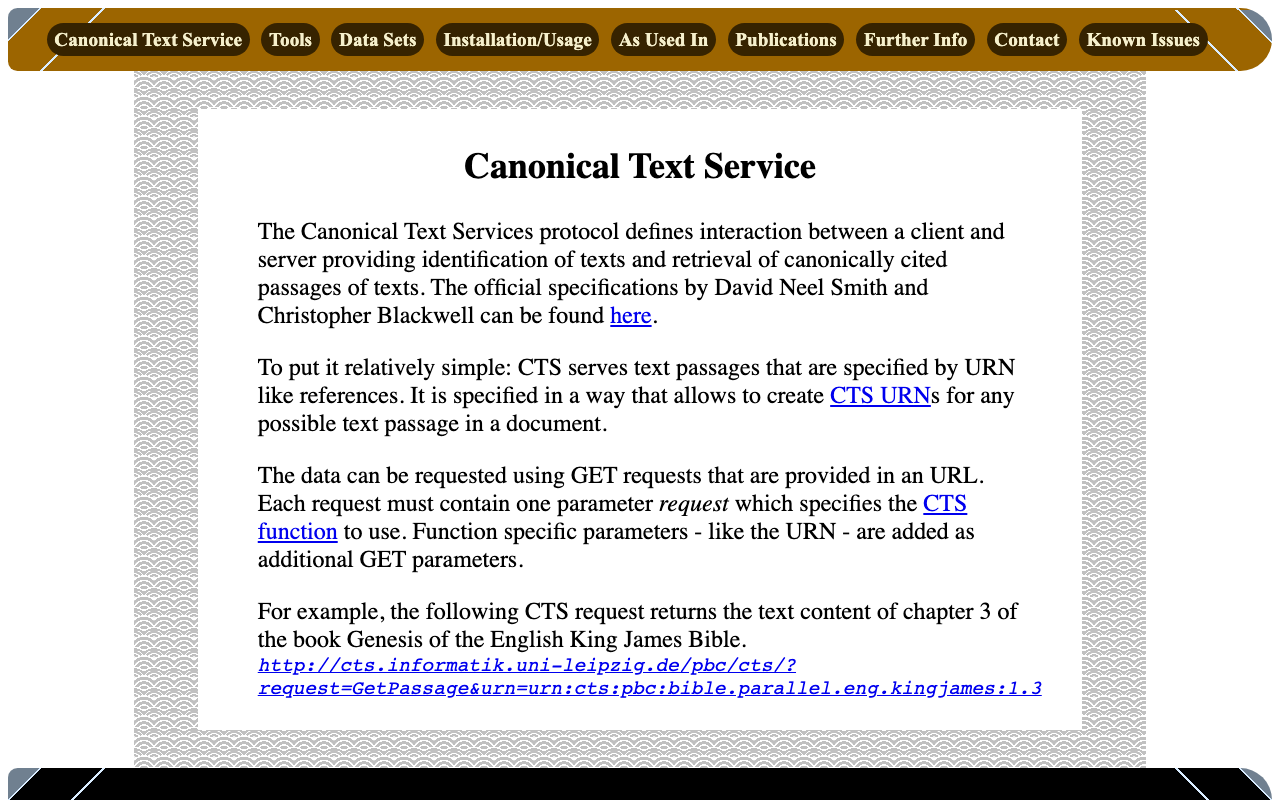
The Canonical Text Services protocol defines interaction between a client and server providing identification of texts and retrieval of canonically cited passages of texts.
The following site was used as a reference.
http://cts.informatik.uni-leipzig.de/Canonical_Text_Service.html
Usage The following was used as a reference.
https://github.com/cite-architecture/cts_spec/blob/master/md/specification.md
GetCapabilities A request to check the services supported by the server.
http://cts.informatik.uni-leipzig.de/pbc/cts/?request=GetCapabilities
<GetCapabilities xmlns="http://relaxng.org/ns/structure/1.0" xmlns:a="http://relaxng.org/ns/compatibility/annotations/1.0" xmlns:tei="http://www.tei-c.org/ns/1.0" xmlns:dc="http://purl.org/dc/elements/1.1/" xmlns:ti="http://chs.harvard.edu/xmlns/cts"> <request>GetCapabilities</request> <reply> <TextInventory tiversion="5.0.rc.1"> <corpuslicense>Public Domain</corpuslicense> <corpussource>http://paralleltext.info/data/</corpussource> <corpuslanguage>arb,ceb,ces,cym,deu,eng,fin,fra,ita,mya,rus,tgl,ukr</corpuslanguage> <corpusname>Parallel Bible Corpus</corpusname> <corpusdescription>The Bible corpus contains 1169 unique translations, which have been assigned 906 different ISO-639-3 codes. This CTS instance contains 20 bible translations from PBC that are available as Public Domain.</corpusdescription> <textgroup urn="urn:cts:pbc:bible"> <groupname>bible</groupname> <edition urn="urn:cts:pbc:bible.parallel.arb.norm:"> <title>The Bible in Arabic</title> <license>Public Domain</license> <source>http://paralleltext.info/data/ retrieved via Canonical Text Service http://cts.informatik.uni-leipzig.de/pbc/cts/</source> <publicationDate>1865</publicationDate> <language>arb</language> <contentType>xml</contentType> </edition> ... </textgroup> </TextInventory> </reply> </GetCapabilities> GetPassage Retrieves a specific portion of text based on a specified URN (Uniform Resource Name).
...
September 4, 2024 · Updated: September 4, 2024 · 2 min · Nakamura