Home Articles Books Search About
日本語
How I Used Claude Code's Parallel Agents to Auto-Generate Videos from 882 Blog Posts

How I Used Claude Code's Parallel Agents to Auto-Generate Videos from 882 Blog Posts

Introduction I run a bilingual (Japanese/English) tech blog with 882 articles. To repurpose this content as YouTube videos, I built an automated pipeline combining Claude Code’s parallel agent feature with VOICEVOX text-to-speech. In the process, I hit Claude Code’s weekly usage limit — something that reportedly affects only the top 2% of users. Here’s how the pipeline works and what I learned. Pipeline Overview Blog article (.md) ↓ Claude Code parallel agents (10 concurrent) Dialogue script (sections.json) ↓ VOICEVOX × 3 parallel workers Narrated video (video.mp4) ↓ YouTube API Published on YouTube 1. Script Generation (Claude Code) Each article is read and converted into a two-character dialogue script (sections.json). Using Claude Code’s Agent tool, 10 agents run simultaneously for parallel processing. ...

Animating IIIF Scroll Paintings with AI Video: A Video Annotation Approach

Animating IIIF Scroll Paintings with AI Video: A Video Annotation Approach

Introduction IIIF (International Image Interoperability Framework) is an international standard for publishing digital archive images in an interoperable format. Adopted by libraries and museums worldwide, it enables deep zoom of high-resolution images and cross-institutional browsing of collections. This article describes the development of “IIIF Animated Viewer,” which overlays AI-generated videos on specific regions of IIIF images. The subject is the “Hyakki Yako-zu” (Night Parade of One Hundred Demons) — a scroll painting depicting a procession of yokai (supernatural creatures) — published by the University of Tokyo. ...

Introducing GitHub File History Analyzer: A Tool for Analyzing File Edit History with AI

Introducing GitHub File History Analyzer: A Tool for Analyzing File Edit History with AI

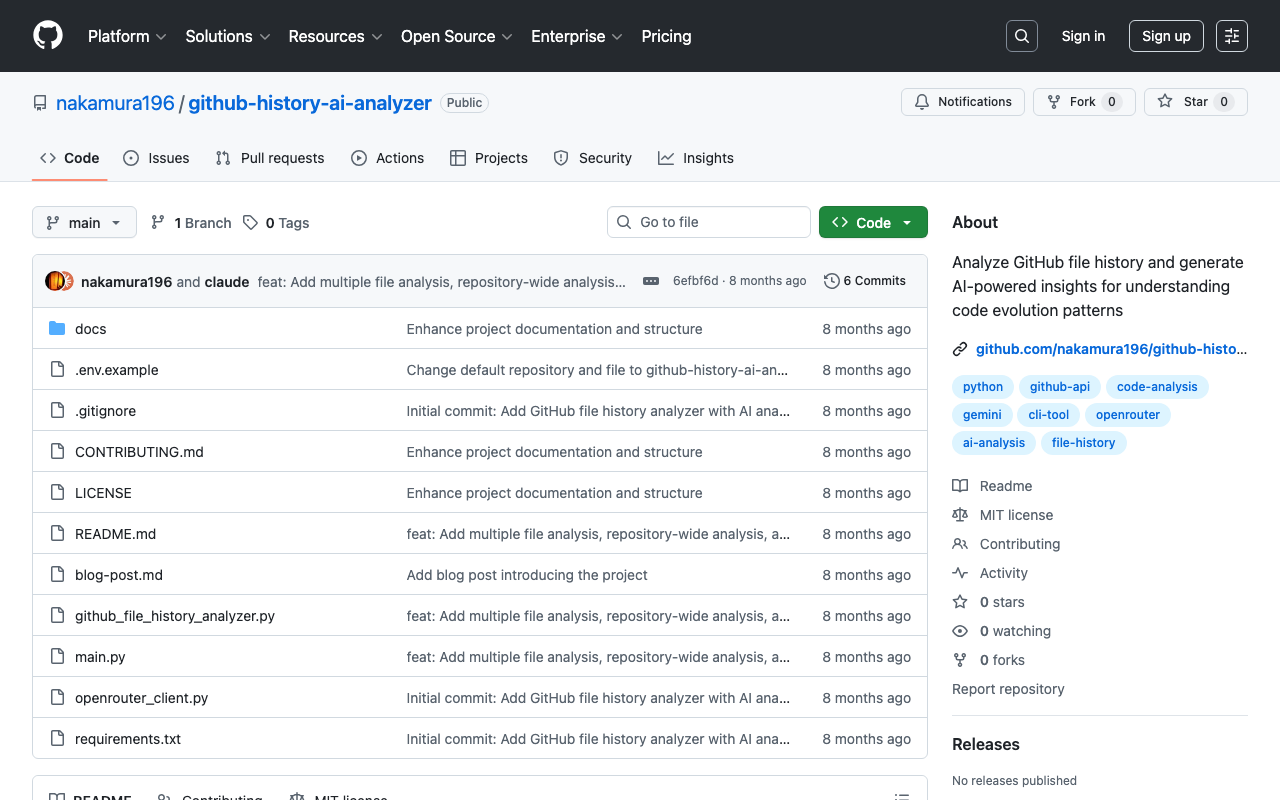
This article was created by AI. Introduction Have you ever wanted to analyze the edit history of files managed in a GitHub repository? There are cases where you want to understand change patterns of files that have been updated over a long period, or the evolution process of a project. GitHub File History Analyzer is a command-line tool developed to meet such needs. Tool Overview This tool provides the following features: ...

GCP: Handling Errors When Creating AI Platform Notebooks

GCP: Handling Errors When Creating AI Platform Notebooks

I created a notebook instance using the following as a reference. https://cloud.google.com/blog/ja/topics/developers-practitioners/pytorch-google-cloud-how-train-pytorch-models-ai-platform gcloud notebooks instances create example-instance \ --vm-image-project=deeplearning-platform-release \ --vm-image-family=pytorch-1-7-cu110-notebooks \ --machine-type=n1-standard-4 \ --location=us-central1-a \ --boot-disk-size=100 \ --accelerator-core-count=1 \ --accelerator-type=NVIDIA_TESLA_T4 \ --install-gpu-driver \ --network=default At that time, I was unable to create the notebook instance due to the following error. ERROR: (gcloud.notebooks.instances.create) The zone 'projects/{project}/zones/us-central1-a' does not have enough resources available to fulfill the request. '(resource type:compute)'. Therefore, I changed the location from us-central1-a to us-central1-b, and was able to create the instance. ...

How to Delete a Feature Store in GCP Vertex AI

How to Delete a Feature Store in GCP Vertex AI

Overview This is a note on how to delete a feature store in Vertex AI on GCP (Google Cloud Platform). I later noticed that official documentation was available at the following link. https://cloud.google.com/vertex-ai/docs/featurestore/managing-featurestores#delete_a_featurestore Method In this example, I will attempt to delete a feature store called test as shown below. It could be deleted by executing the following command. (I was unable to find a way to delete it from the GUI.) ...