Overview
I developed a new feature for the Omeka S IIIF Server module that adds a setting to disable the Image API. This makes it easier to deliver IIIF manifests and other content in environments with limited resources, such as shared hosting servers. I hope this feature contributes to improving the sustainability and usability of digital archive systems.
Background
The Omeka S IIIF Server module generates IIIF manifest files from metadata registered in Omeka S. It is primarily developed by Daniel-KM, who has developed various Omeka modules.
For images, an Image Server is required. You can either set up a separate IIIF Image Server listed in Awesome IIIF alongside Omeka S, or use the Omeka S Image Server module. The latter can be implemented with Omeka S alone, enabling the delivery of IIIF-compliant images and manifest files using a shared hosting server with a LAMP environment. While shared hosting servers have limited CPU and memory resources, their advantage is low maintenance cost.
However, there are challenges when deploying the Omeka S Image Server module in resource-limited environments such as shared hosting servers. It was observed that when the Image Server module dynamically delivers tile images, this processing takes time and delays the display of tile images. (Note: An option to pre-generate tile images is also provided. While this eliminates the need to generate tile images for each request, it has the disadvantage of increased disk usage.)
Solution
In IIIF manifests, it is not always necessary to conform to the IIIF Image API; it is also possible to simply reference plain JPEG images. (Note: This limits functionality such as dynamic resizing, rotation, and cropping of images.)
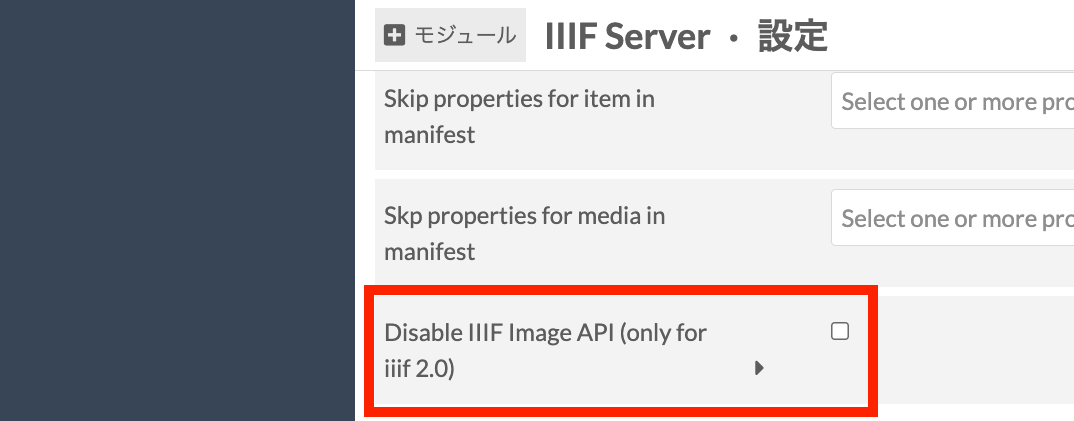
Therefore, as a new option for delivering IIIF manifests using Omeka S in resource-limited environments such as shared hosting servers, I added a setting to the IIIF Server module that uses JPEG images registered in Omeka S as-is, without using the Image API. This feature is available from version 3.6.4.3 onward.
Specifically, it can be enabled on the following settings screen of the IIIF Server module:
This module is used in the Engineering Historical Materials Curation Database at the University of Tokyo Engineering and Information Science & Technology Library.
curation.library.t.u-tokyo.ac.jp
As mentioned above, enabling this setting limits some IIIF functionality, so it is not necessarily the optimal approach. However, I hope this feature serves as a useful option for delivering IIIF manifests on servers with limited resources.